SEBI Weighs a Free-Float Cap on MTF: What's Proposed
SEBI has not changed any MTF rules yet. It is weighing a proposal to link margin funding in a stock to its free float, but the chairman says no decision has been taken.
Chartist, Research Analyst and Investor
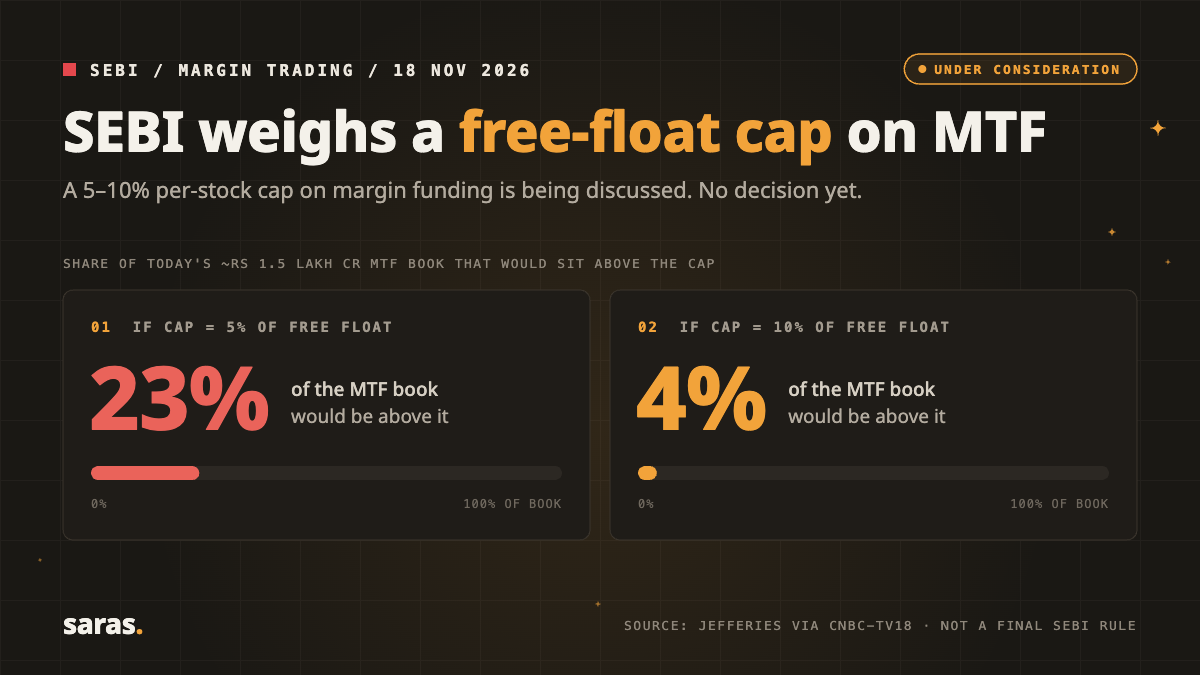
SEBI has not changed any Margin Trading Facility (MTF) rules this week. What it is doing is weighing a proposal to link how much margin funding a stock can attract to that stock's free float.
A Reuters report on 17 November 2026 said the cap under study could be 5% to 10% of a company's free float. A day later, SEBI Chairman Tuhin Kanta Pandey told CNBC-TV18 that the idea is under consideration but no decision has been taken. Here is what MTF is, what is being discussed, and what is (and isn't) official.
First, what is MTF?
MTF lets you buy shares by paying only part of the value upfront. Your broker funds the rest and charges interest, and the shares you buy are pledged as security. If prices fall and your margin drops below the required level, the broker asks for more margin or sells the position.
Today's rules, set out in SEBI's Master Circular (Chapter 1, Trading, section 4), cover three things:
- Which securities qualify: only Group I equity shares and equity ETFs, which are the more liquid, frequently traded ones.
- Initial margin: VaR + 3 times ELM for Group I stocks traded in F&O, and VaR + 5 times ELM for other Group I stocks and equity ETFs.
- Who can offer it: brokers with a net worth of at least ₹3 crore.
There is currently no limit linked to how many of a company's shares are actually available to trade.
What SEBI is reportedly considering
The idea is to cap MTF exposure in each stock at a percentage of that stock's free float. Free float is the part of a company's shares available for public trading, so it excludes promoter holdings and other locked-in shares.
The reasoning, as reported, is simple. When a stock has few freely traded shares, a large pile of borrowed money in it can push prices around and make forced selling much more painful. Linking funding to free float would stop leverage from building up where liquidity is thinnest.
A hypothetical example (no real company): say a stock's free float is worth ₹2,000 crore.
- A 5% cap would allow at most ₹100 crore of MTF exposure in that stock.
- A 10% cap would allow at most ₹200 crore.
The 5% to 10% range comes from media reports, not from SEBI. Key details are also unknown, including whether the cap would apply market-wide or per broker, and what would happen to positions already open.
Where things stand: nothing decided yet
As of 18 November 2026, this is a proposal under discussion and nothing more.
- No decision: On 18 November, Chairman Tuhin Kanta Pandey told CNBC-TV18 that the proposal is under consideration and that no decision has been taken yet. He said the topic came up at a recent committee meeting.
- No timeline: none has been announced.
- No official document: SEBI has not issued a consultation paper, circular or press release on a free-float cap. The cap percentage comes from an unnamed-source Reuters report.
If SEBI does go ahead, it usually publishes a consultation paper for public comment first, which would set out the actual numbers.
Don't confuse it with the June 2026 MTF proposals
SEBI's only official MTF document this year is its Consultation Paper on Review of MTF Framework, dated 18 June 2026. It deals mainly with brokers, not stocks, and makes no mention of a free-float cap. Its main proposals:
- Higher broker net worth: raise the minimum for brokers offering MTF from ₹3 crore to ₹5 crore.
- Ring-fenced net worth: keep the lower of twice the broking net-worth requirement or 50% of net worth for core broking. The rest can fund MTF, within an overall exposure cap of 5.5 times net worth.
- More funding options: let brokers raise money for MTF through non-convertible debentures (NCDs).
- LLP brokers: allow brokers set up as LLPs to offer MTF.
- Operational relief: for example, relief when a client-level exposure limit is breached passively.
Public comments closed on 9 July 2026. As of this writing, SEBI has not issued a final circular on these proposals.
How big is MTF, and what could a cap mean?
According to brokerage Jefferies, as reported by CNBC-TV18, India's MTF book has roughly doubled in two years to about ₹1.5 lakh crore. That is only around 0.7% of total free-float market capitalisation.
How much of the book a cap would affect depends heavily on the level SEBI picks. Jefferies estimates that about 4% of today's MTF book is above a 10% cap, compared with about 23% above a 5% cap. Jefferies expects a cap to shift leverage from smaller stocks toward larger, more liquid ones rather than cut overall participation. Macquarie expects limited disruption, since brokers are already curbing speculative activity.
If a cap is introduced, MTF users might see:
- Funding limits in low-float stocks: new MTF funding could stop once a stock reaches its cap.
- Bigger impact on small and illiquid stocks: heavily funded small, low-float stocks would be hit first. Large, widely held stocks are less likely to come near a cap.
- Changes at brokers: brokers may tighten their own eligible-stock lists or margins ahead of any formal rule.
All of this depends on the final design, which SEBI has not announced.
What to watch next
- A SEBI consultation paper on the cap: this would give the actual percentage and how the cap would be applied.
- A final circular on the June 2026 proposals: this would settle the broker net-worth and funding changes.
- Notices from your broker: any changes to its MTF-eligible stock list or margin requirements.
We will update this article when SEBI publishes anything official.
Sources
Official (SEBI)
- Consultation Paper on Review of Margin Trading Facility (MTF) Framework, 18 June 2026
- Master Circular for Stock Exchanges and Clearing Corporations, Chapter 1: Trading
Media reports (not official)
This article is for educational purposes only and is not investment advice or a recommendation to buy, sell or hold any security. It describes a regulatory proposal that has not been finalised, and details may change.
Investment in securities market are subject to market risks. Read all the related documents carefully before investing.
This page is education, not advice. It explains how things work. It does not recommend any security or any action.
- 11FII Buying in November 2026: Why Foreign Investors Are Back and DIIs Are SellingForeign investors bought a record ₹84,290 crore of Indian shares in early November 2026 while DIIs and mutual funds sold. Here's what the FII DII data shows and why it happened.
- 12The Economist's 2027 Trends: 5 That Matter for Indian InvestorsThe Economist's World Ahead 2027 lists ten trends for next year. These five have the clearest link to Indian markets, from oil and the monsoon to FPI flows and pharma.
Saras is coming soon. Join the waitlist and we will let you know when it opens.