FII Buying in November 2026: Why Foreign Investors Are Back and DIIs Are Selling
Foreign investors bought a record ₹84,290 crore of Indian shares in early November 2026 while DIIs and mutual funds sold. Here's what the FII DII data shows and why it happened.
Microcap Specialist, Research Analyst and 7+ Years in Markets
Quick summary
- Foreign investors (FIIs/FPIs) bought about ₹84,290 crore of Indian shares between 2 and 13 November 2026. That's roughly $8.9 billion, the biggest monthly buying since NSDL data began in 2002.
- This comes after FIIs sold ₹2.95 lakh crore of Indian stocks between January and October.
- Sensex and Nifty are up around 10% in November and are at their highest levels since February.
- On the other side, domestic institutions (DIIs) and mutual funds are selling. Mutual funds turned net sellers for the first time since April 2023.
- The main reasons: cheaper crude oil, a steadier rupee, global money moving out of AI stocks, and FIIs being forced to cover their short bets in Nifty futures.
First, what are FIIs and DIIs?
FII (Foreign Institutional Investor), now officially called FPI (Foreign Portfolio Investor), is a big investor from outside India: global mutual funds, pension funds, hedge funds and so on. They put money into Indian shares and bonds.
DII (Domestic Institutional Investor) is a big Indian investor: mutual funds, insurance companies like LIC, banks and pension funds. Much of their money comes from regular people's SIPs and insurance premiums.
Why does this matter? FIIs and DIIs move huge amounts of money. When FIIs buy heavily, large-cap stocks like banks usually go up. When they sell, the market often falls unless DIIs step in to buy. That's why traders check FII DII data every evening.
How big is the November 2026 FII buying?
It's the biggest on record. Here's the simple picture:
- September 2026: FPIs sold ₹35,861 crore
- October 2026: FPIs sold ₹34,843 crore
- November 2026 (2–13 Nov): FPIs bought ₹84,290 crore
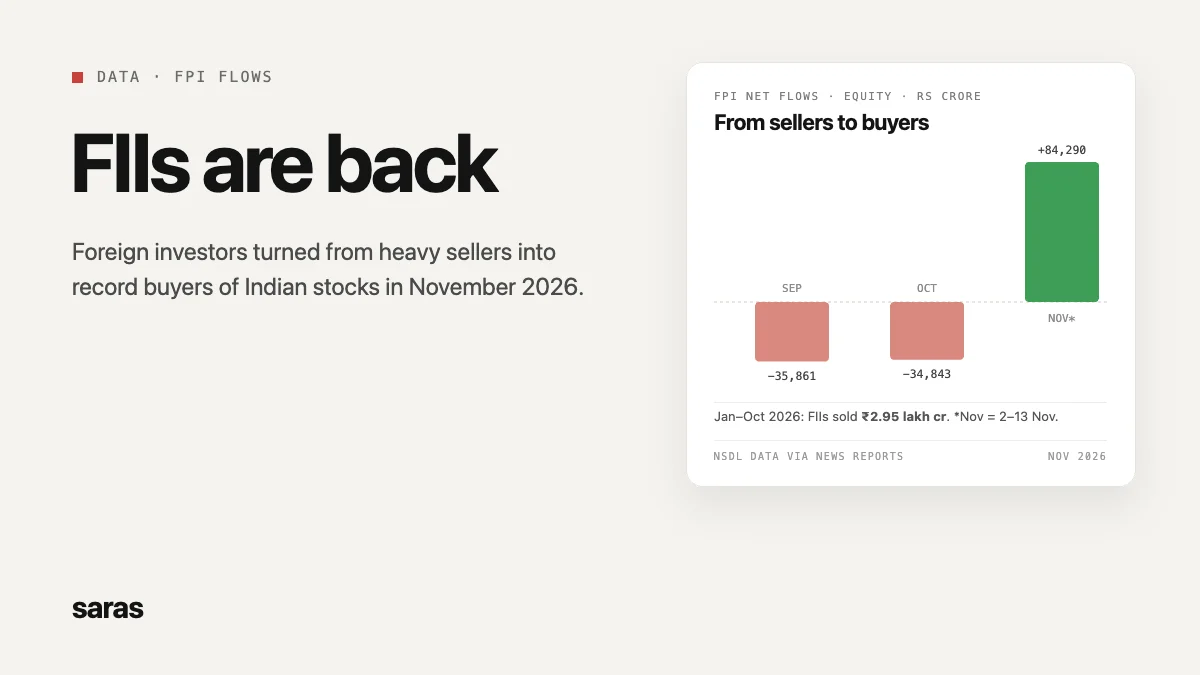
In just nine trading sessions, foreign investors wiped out two months of selling and then some. On a single day, 12 November, FIIs bought ₹12,563 crore of shares.
They also bought Indian bonds: about ₹7,815 crore through the fully accessible route (FAR) and ₹1,167 crore through the general route in the same period.
But keep it in context. Even after November, 2026 is still a net selling year for FPIs, at about ₹2.1 lakh crore. So this is a strong comeback, not a full reversal yet.
Note on numbers: You'll see different totals in the news ($5.68 bn, $6.43 bn, $8.9 bn, ₹73,261 cr, ₹84,290 cr). That's because each report covers a different number of days, and some count only FIIs while others include all FPIs. Always check the date range.
FII vs DII: who is on the other side?
Every trade has a buyer and a seller. If FIIs are buying so much, who is selling to them? The answer is Indian institutions.
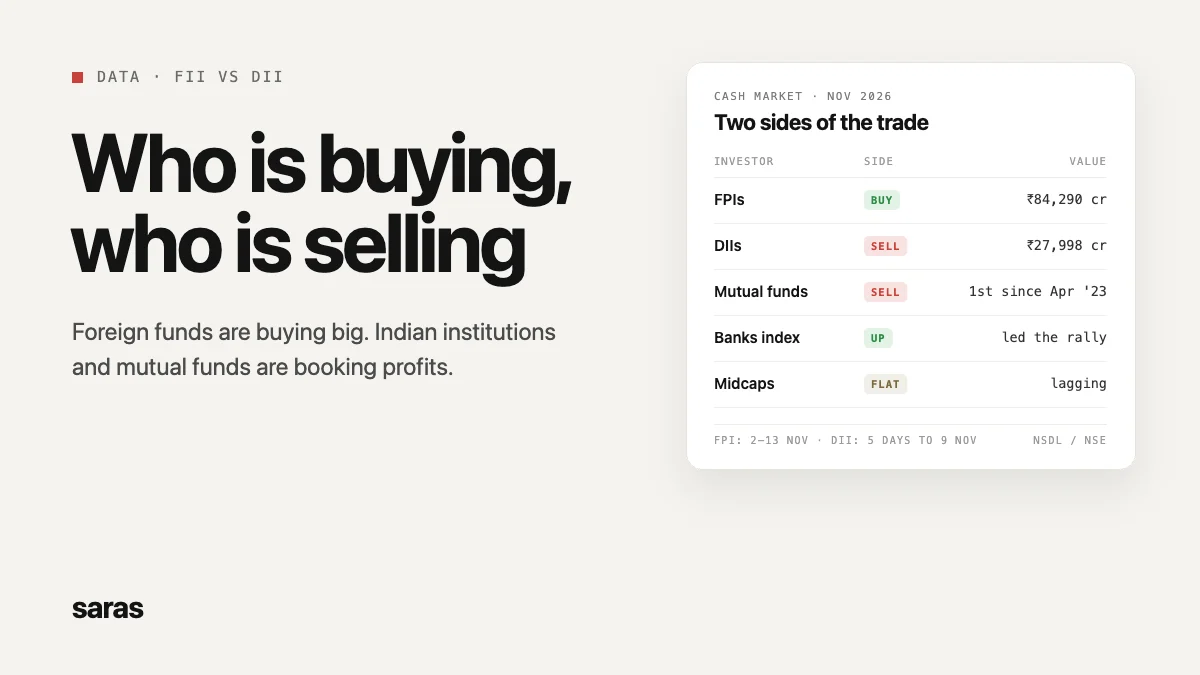
- DIIs sold about ₹27,998 crore in just five sessions up to 9 November. Market commentators call this the heaviest DII selling on record.
- Mutual funds were net sellers in November, the first time since April 2023.
Why would Indian funds sell? A few likely reasons:
- Profit booking. DIIs bought heavily all year while FIIs were selling. Now that prices are up about 10%, they're taking some profit.
- Rebalancing. Funds have rules about how much they can hold in one stock or sector. When banks rally hard, they may need to trim.
- Liquidity. Some funds keep cash ready for redemptions or new IPOs.
So this is a role swap. For most of 2026, DIIs held the market up while FIIs sold. In November, FIIs are pushing it up while DIIs sell.
Why did FIIs come back now?
Five things came together at once.
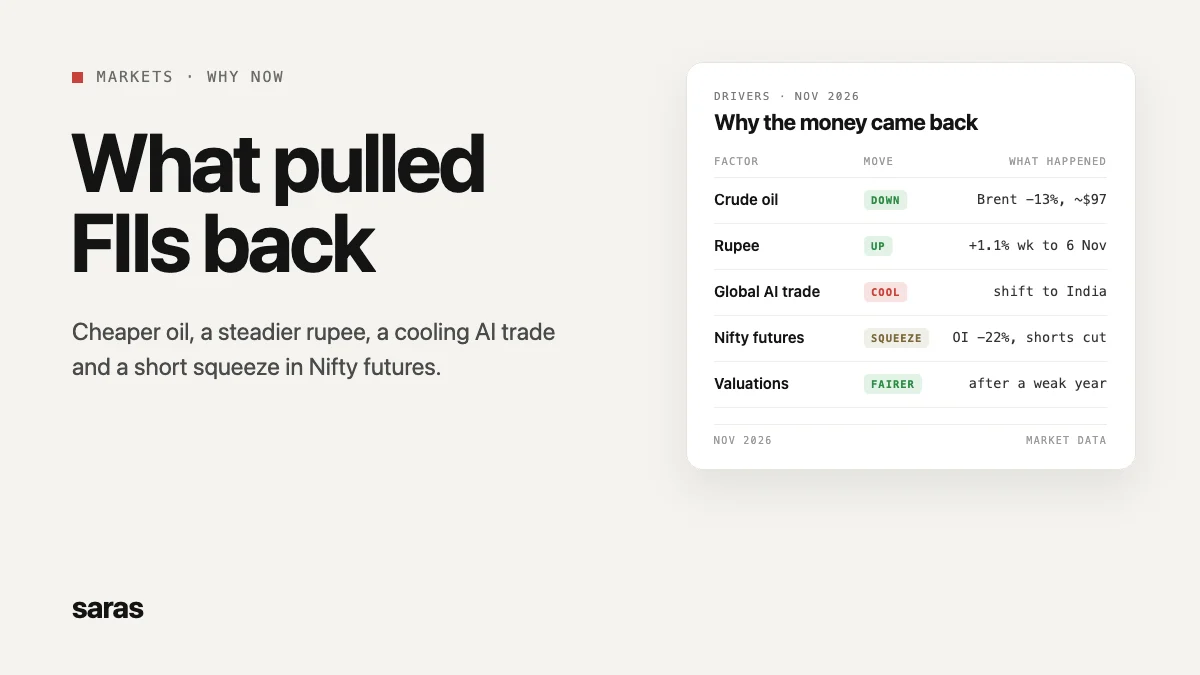
1. Crude oil fell. India imports most of its oil. Brent crude fell about 13% in the first week of November to near $97 a barrel. Cheaper oil means India spends fewer dollars on imports, which is good for the rupee, inflation and company profits.
2. The rupee got stronger. The rupee rose about 1.1% in the week to 6 November, its best week since April. For a foreign investor, returns = stock gains + currency gains. A stable rupee means they don't lose money on the exchange rate.
3. The global AI trade cooled. For almost two years, global money chased AI stocks in the US and elsewhere, and India was left behind. As that trade cooled, money started looking for other markets, and India stood out.
4. Short covering in Nifty futures. By late October, FIIs had built very large bearish (short) positions in index futures, meaning they were betting the market would fall. When the market started rising, they had to buy back those futures to limit losses. That extra buying added fuel to the rally. By 6 November, net shorts had fallen to about one lakh contracts and Nifty futures open interest had dropped about 22%.
5. Valuations looked fairer. After a weak year, Indian stocks were no longer as expensive as before. Hopes of steady earnings, resilient local demand and talk of a possible cut in equity taxes also helped.
Where is the money going?
Mostly into big banks and financial stocks. Financials were up about 12.6% in November (as of 11 November), the biggest push among index heavyweights. PSU banks also rallied.
On 17 November, Sensex closed at 82,532 and Nifty at 25,387, their highest levels since February, led by banking stocks.
Midcaps and smallcaps are lagging. The rally is concentrated in large caps, which is typical of FII buying: foreign funds need big, liquid stocks they can enter and exit easily.
It's not all green either. Tata Motors Passenger Vehicles fell 8% on 16 November after reporting a quarterly loss. FII money doesn't save stocks with weak results.
What could reverse this?
FII money is fast money. It can leave as quickly as it came. Watch these risks:
- Crude oil bounces back above $100. That would hurt the rupee and revive inflation worries.
- Rupee weakens. Foreign investors lose on currency even if stocks rise.
- Retail inflation rises. India's September inflation came in higher, which could delay rate cuts.
- US interest rates and bond yields. Hawkish signals from the US Fed or higher US yields pull money back to America.
- Geopolitics. Iran–US tensions could push oil up again.
- Global sell-off. Wall Street saw a heavy sell-off on 17 November. India held up that day, but a bigger global risk-off move could drag everyone down.
- DIIs keep selling. If domestic funds keep booking profit, they can cap how far the rally goes.
What does this mean for you?
This is not investment advice. It's a way to think about the data.
- Don't chase blindly. A 10% jump in a few weeks, partly from short covering, can see sharp pullbacks.
- Watch the daily flows. If FII buying slows and DII selling continues, the rally may lose steam.
- Large caps vs midcaps. FII money is going into big banks. If you hold mostly midcaps or smallcaps, your portfolio may not reflect the index rally, and that's normal.
- Position size matters. Keep each bet small enough that a sudden reversal doesn't hurt badly.
How to track FII DII data every day
You can check daily FII and DII buying and selling in the cash market on the Saras FII and DII data page. It shows net value by day for FII/FPI and DII, so you can quickly see who's buying and who's selling.
For bigger single trades, check the Saras Block deals page. It lists block deals on NSE from the last trading day: the stock, the buyer or seller, quantity and price.
Official sources: NSDL (FPI monthly and fortnightly data) and NSE/BSE (provisional daily FII/DII data).
Disclaimer: This article is for education and information only. It is not a recommendation to buy or sell any security. Figures are from NSDL and exchange data as reported in the news and may be revised. Please do your own research or consult a SEBI-registered adviser before investing.
Questions and answers
What is FII buying and why does it move the market?
FII buying is when foreign institutions buy Indian shares. They trade in very large amounts, mostly in big stocks, so their buying can push Sensex and Nifty up quickly.
How much did FIIs buy in November 2026?
About ₹84,290 crore (around $8.9 billion) between 2 and 13 November 2026, as per NSDL data. That's the biggest single-month buying since records began in 2002.
Why are DIIs and mutual funds selling when FIIs are buying?
Mostly profit booking and rebalancing. DIIs bought through most of 2026 while FIIs sold. After a roughly 10% rally, they're trimming some positions.
What is the difference between FII and FPI?
In practice they mean the same thing: foreign investors putting money into Indian markets. SEBI now uses the term FPI, but FII is still common in news and daily data.
Is FII buying a good time to invest?
It shows strong foreign demand, but flows can reverse fast if crude, the rupee or global markets turn. Look at your own goals and time frame, and don't invest only because FIIs are buying.
Where can I check FII DII data daily?
NSE and BSE publish provisional FII/DII cash market data after market hours. NSDL publishes detailed FPI data. You can also see daily net values on the Saras FII and DII data page.
This page is education, not advice. It explains how things work. It does not recommend any security or any action.
- 12The Economist's 2027 Trends: 5 That Matter for Indian InvestorsThe Economist's World Ahead 2027 lists ten trends for next year. These five have the clearest link to Indian markets, from oil and the monsoon to FPI flows and pharma.
- 13Silver Price Crash 2026: MCX Silver Down 65% to ₹1.48 Lakh – Opportunity or Trap?MCX silver fell from a record ₹4.21 lakh to ₹1.48 lakh per kg. Why silver crashed in 2026, what past crashes show, the supply deficit and long-term demand. For learning only, not advice.
Saras is coming soon. Join the waitlist and we will let you know when it opens.