The Economist's 2027 Trends: 5 That Matter for Indian Investors
The Economist's World Ahead 2027 lists ten trends for next year. These five have the clearest link to Indian markets, from oil and the monsoon to FPI flows and pharma.
Chartist, Research Analyst and Investor
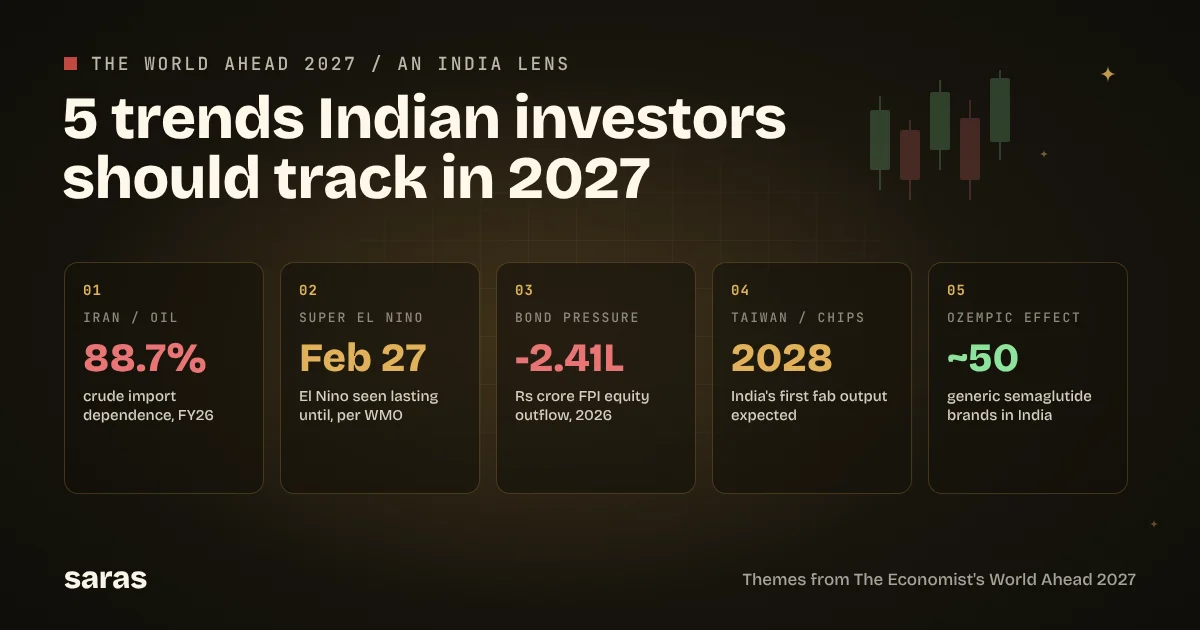
The Economist published its annual World Ahead outlook on 17 November 2026. In a letter summarising the edition, editor Tom Standage picks ten themes to watch in 2027, from the race to succeed Donald Trump to a reboot of Hollywood.
Most of the list is about America, Europe and technology. But five of the ten trends have a direct line to Indian markets. Below, we take each one, sum up what The Economist expects in a sentence, and then look at what it could mean for India using the latest official and reported data.
1. Aftershocks from Iran: oil and fertiliser
What The Economist expects: no clean end to the conflict, with its effects reshaping energy flows through 2027 and threatening food security as fertiliser stays in short supply.
Why it matters for India: India buys most of its oil abroad. The government told the Rajya Sabha in July 2026 that India's crude import dependence hit a record 88.7% in 2025-26 (provisional), up from 85.5% in 2021-22. The bill is rising fast: India's crude import bill jumped 56.5% to $63.4 billion in April-July 2026, from $40.5 billion a year earlier.
Fertiliser is the second channel. According to Crisil Ratings, India imports about 30% of its fertiliser requirement, and the Middle East supplies nearly 40% of those imports. Domestic urea plants depend on the region too: nearly 86% of the LNG used by India's fertiliser plants comes from West Asia.
What to watch: crude prices, the rupee, the fertiliser subsidy bill in the next Union Budget, and margins at oil marketing companies and fertiliser makers.
2. A super El Nino: the monsoon and food prices
What The Economist expects: 2027 to be the hottest year on record, with a super El Nino bringing more droughts, heatwaves and wildfires.
Why it matters for India: El Nino usually weakens India's monsoon. The World Meteorological Organization has said current El Nino conditions are likely to strengthen into a very strong event and persist through February 2027. The 2026 monsoon was already below normal: India received about 12% less rain than normal between 1 June and 13 August 2026.
A weak monsoon can hurt farm output, rural demand and food inflation, and food inflation in turn affects how much room the RBI has on interest rates.
What to watch: IMD's first forecast for the 2027 monsoon (usually issued in April), food inflation in the monthly CPI data, and rural demand indicators such as tractor and two-wheeler sales.
3. Bond-market pressure: foreign money and the rupee
What The Economist expects: heavy government spending, the AI construction boom and energy-driven inflation pushing up borrowing costs across rich countries. Its verdict: "Something, somewhere, has to break."
Why it matters for India: when bond yields rise in the US and other rich countries, foreign investors can earn safer returns at home, and emerging markets such as India lose some appeal. 2026 has already shown this. According to NSDL data, cumulative FPI outflows from Indian equities in 2026 stood at Rs 2.41 lakh crore even after FPIs invested Rs 53,739 crore in the first nine days of November. March alone saw a record Rs 1.17 lakh crore of outflows.
Higher global yields also weigh on the rupee. It started 2026 at about 90 to the US dollar and breached 96 on 15 May 2026.
What to watch: US 10-year Treasury yields, India's 10-year government bond yield, daily FII and DII flows, and the rupee.
4. Taiwan's deadline: chips and electronics
What The Economist expects: Xi Jinping is said to have set 2027 as the year China's armed forces should be ready to take Taiwan, which makes the next two years risky.
Why it matters for India: Taiwan is central to the world's chip supply, so any disruption there would hit electronics, autos and other industries that run on semiconductors, in India as much as anywhere. India's own chip-making plans are still a few years from scale: Tata Electronics' Dholera fab, built with Taiwan's PSMC, is now expected to begin commercial production in mid-2028, starting with 90nm technology before 28nm.
What to watch: cross-strait tensions, and progress at India's semiconductor and electronics manufacturing projects.
5. The Ozempic effect: Indian pharma
What The Economist expects: weight-loss drugs changing how people spend, with the newly slim spending more on clothes, cosmetics and fitness, and drugmakers showing fresh interest in longevity treatments.
Why it matters for India: Indian drugmakers are already in this race. Semaglutide, the molecule behind Ozempic and Wegovy, went off patent in India on 20 March 2026, and about 50 brands lined up to launch. Companies including Natco, Sun Pharma, Zydus and Dr Reddy's announced generic versions. Prices fell sharply: branded semaglutide cost Rs 10,850 to Rs 16,400 a month before the patent expired, while generic monthly treatments started at about Rs 1,300.
What to watch: price competition in India, export launches as semaglutide patents expire in other countries (Dr Reddy's has said it is targeting 87 countries), and whether spending on apparel and fitness picks up, as The Economist expects.
The five trends we left out
The other five themes are the post-Trump era in America, a growing backlash against AI, Europe's populist right (with Marine Le Pen a strong contender in France's 2027 presidential election), cheaper space launches, and the reboot of Hollywood. They matter globally, but their link to Indian markets is less direct, at least for now.
How to use this list
Year-ahead forecasts like this one are not calls on specific stocks. They are a checklist of risks to track. For Indian investors, the five threads above mostly run through a handful of numbers: crude oil prices, the monsoon, global bond yields, FPI flows and the rupee.
Sources
The Economist
India data (official statements and news reports)
- ThePrint: crude import dependence at record 88.7% (Rajya Sabha reply), 27 Jul 2026
- ThePrint: crude import bill at $63.4 billion in April-July, 19 Aug 2026
- Business Today: fertiliser import dependence (Crisil Ratings), 6 Mar 2026
- Business Today: LNG for fertiliser plants, 18 Mar 2026
- The Tribune: WMO says El Nino to persist through Feb 2027
- Outlook Business: 2026 monsoon rainfall deficit
- NewKerala: FPI flows in November 2026 and year to date (NSDL data)
- Outlook Business: FPI outflows and the rupee, May 2026
- Angel One (citing Bloomberg): Tata Electronics Dholera fab timeline, 17 Jul 2026
- Business Today: semaglutide goes generic in India, 20 Mar 2026
- Outlook Business: 50 brands in the post-patent semaglutide market
Disclaimer: This article is for informational purposes only and is not investment advice.
Questions and answers
What are The Economist's ten trends to watch in 2027?
According to editor Tom Standage's World Ahead 2027 letter, the ten themes are the post-Trump era, aftershocks from Iran, the hottest year on record, a growing AI backlash, Europe's populist right, bond-market pressure, Taiwan's 2027 deadline, the Ozempic effect, cheaper space launches and a reboot of Hollywood.
Which of The Economist's 2027 trends matter most for Indian investors?
Five have the clearest link to Indian markets: the Iran conflict (oil and fertiliser), a super El Nino (the monsoon and food prices), bond-market pressure (FPI flows and the rupee), Taiwan (chip supply) and the Ozempic effect (Indian generic drugmakers).
How could El Nino affect India in 2027?
El Nino usually weakens India's monsoon. The WMO has said current El Nino conditions are likely to persist through February 2027. A weak monsoon can hurt farm output, rural demand and food inflation, which also affects the RBI's room on interest rates.
Why do rising global bond yields matter for Indian markets?
Higher yields in the US and other rich countries give foreign investors safer returns at home, which can pull money out of emerging markets such as India. FPI outflows from Indian equities in 2026 stood at Rs 2.41 lakh crore by mid-November, according to NSDL data.
This page is education, not advice. It explains how things work. It does not recommend any security or any action.
- 13Silver Price Crash 2026: MCX Silver Down 65% to ₹1.48 Lakh – Opportunity or Trap?MCX silver fell from a record ₹4.21 lakh to ₹1.48 lakh per kg. Why silver crashed in 2026, what past crashes show, the supply deficit and long-term demand. For learning only, not advice.
- 14IndusInd Bank Crosses Rs 1,000: What Is Driving the RallyIndusInd Bank rose about 8% on 20 November and crossed Rs 1,000 for the first time since July, without any company news. Here is what is behind the move and what to watch.
Saras is coming soon. Join the waitlist and we will let you know when it opens.