Why Kaynes Technology Shares Fell 20%: Profit, Debt and Auditor Review
Kaynes Technology shares fell up to 20% after Q2 FY27 results. Here is what the NSE filing shows on profit, net debt and the auditor's qualified review.
Chartist, Research Analyst and Investor
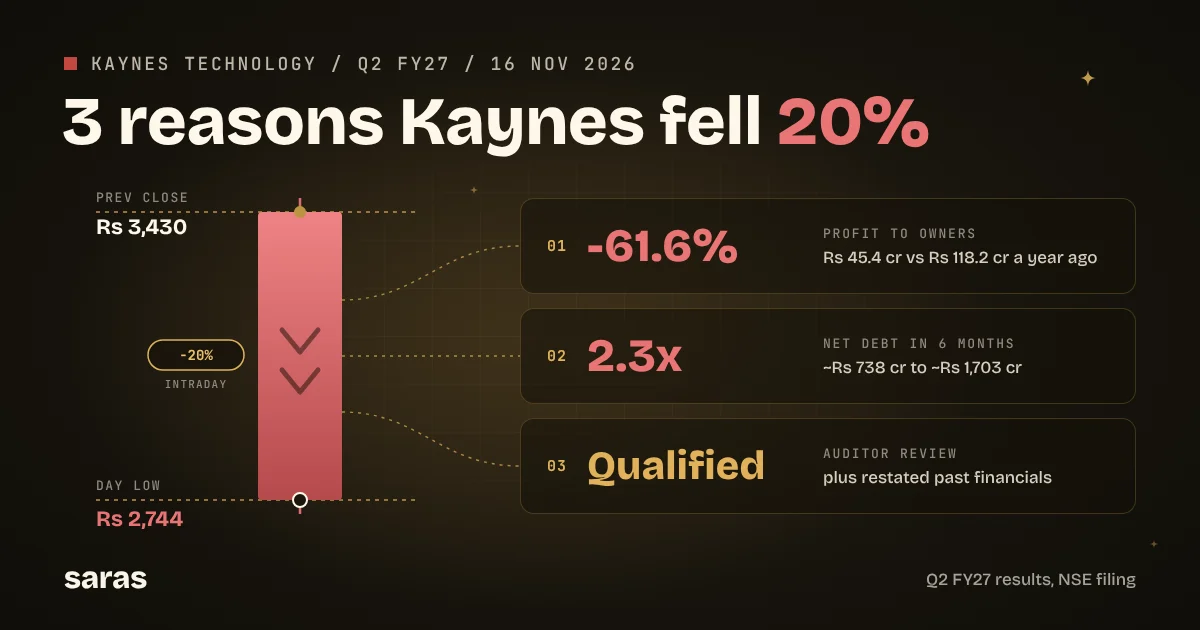
Kaynes Technology India shares fell as much as 20% intraday on Monday, 16 November 2026, touching a low of Rs 2,744 against the previous close of Rs 3,430, according to market reports. The trigger was the company's Q2 FY27 results, filed with the exchanges on 14 November 2026.
Revenue barely grew. Revenue from operations came in at Rs 952.5 crore, up just 4.4% from Rs 912.1 crore a year ago. But the real story is in three other parts of the filing: profit, debt and the auditor's review report.
1. Profit fell more than 60%
Kaynes reported two profit numbers this quarter, and different news reports quoted different ones. Both are correct. They measure different things.
Consolidated (Rs crore) | Q2 FY27 | Q2 FY26 (restated) | Change |
|---|---|---|---|
Profit for the period | 39.8 | 115.7 | -65.6% |
Profit attributable to owners | 45.4 | 118.2 | -61.6% |
Basic EPS (Rs) | 6.76 | 17.64 | -61.7% |
Why two numbers? "Profit for the period" is the profit of the whole group. "Profit attributable to owners" is the part that belongs to Kaynes shareholders. The gap comes from non-controlling interest: subsidiaries that Kaynes does not fully own made a loss, and the minority partners' share of that loss (about Rs 5.6 crore) is taken out.
For a shareholder, the owners' number and EPS are the ones that matter. On that basis, profit fell 61.6%.
Note that the Q2 FY26 comparison figures are restated. Kaynes corrected errors in its past financials this quarter, so last year's numbers in this filing are not the same as the ones originally reported.
2. Net debt more than doubled in six months
This is the part of the filing that worries the market most.
Consolidated (Rs crore) | 30 Sep 2026 | 31 Mar 2026 |
|---|---|---|
Total borrowings | 1,809.8 | 1,393.7 |
Cash and bank balances | 106.7 | 655.4 |
Net debt (approx.) | 1,703 | 738 |
Two things happened together. Borrowings went up by about Rs 416 crore, and cash and bank balances fell by about Rs 549 crore. Net debt rose by roughly Rs 965 crore in just six months.
Where did the money go? Operating cash flow for the first half of FY27 was negative Rs 278.4 crore. In simple terms, the business used more cash than it generated from operations, and that gap was funded by debt and existing cash.
Higher debt also means higher interest. Finance costs for the quarter were Rs 38.7 crore, about 2.9 times the Rs 13.3 crore of Q2 FY26 (restated).
Net debt here is calculated as total borrowings minus cash and other bank balances. It excludes lease liabilities and liquid investments, so treat it as an approximate figure.
3. The auditor gave a qualified review
Every quarter, a listed company's auditor does a "limited review" of its results. Usually the conclusion is clean. This time, it was not.
The auditor's conclusion on the consolidated results is qualified, which means it carries an "except for" exception. The issue is the group's share of the loss of an associate company, Mixx Technologies. The auditor said it was unable to comment on any adjustments that may be needed to that share of loss.
The auditor also drew attention to Note 10 of the results, which describes the restatement of past financials. Kaynes said it corrected "material prior period errors" under accounting standard Ind AS 8. The corrections cover areas like revenue recognised before control had passed to the customer, lease accounting, accounting for associates, inventory and tax. The impact is large at the standalone level: FY26 standalone net profit was revised from Rs 254.1 crore to Rs 182.0 crore, a cut of about 28%.
Why this matters
Any one of these on its own might not have caused a 20% fall. Together, they paint a harder picture:
- Profit fell over 60% while revenue grew only 4.4%
- The company is burning cash and funding it with debt
- The auditor has qualified its review, and past numbers have been corrected
For investors, the key questions now are whether operating cash flow turns positive, whether debt stops rising, and whether the next review report comes back clean.
About this data
All company figures are from Kaynes Technology India Ltd's unaudited financial results for the quarter and half year ended 30 September 2026, filed with NSE on 14 November 2026. Share price levels are from market reports. Net debt and the EPS change are calculated from figures in the filing.
Disclaimer: This article is for informational purposes only and is not investment advice.
Questions and answers
Why did Kaynes Technology shares fall on 16 November 2026?
The shares fell after Q2 FY27 results showed a 61.6% fall in profit attributable to owners, net debt rising to about Rs 1,703 crore, a qualified auditor review and a restatement of past financials.
What was Kaynes Technology Q2 FY27 net profit?
Profit attributable to owners was Rs 45.4 crore, down 61.6% from Rs 118.2 crore (restated) a year ago. Total profit for the period, including non-controlling interest, was Rs 39.8 crore.
What is the qualified review in Kaynes Technology Q2 FY27 results?
The auditor qualified its limited review over the group's share of loss in associate company Mixx Technologies, saying it could not comment on any adjustments that may be needed to it.
Did Kaynes Technology restate its financials?
Yes. Kaynes restated earlier periods to correct material prior period errors under Ind AS 8. FY26 standalone net profit was revised down from Rs 254.1 crore to Rs 182.0 crore.
This page is education, not advice. It explains how things work. It does not recommend any security or any action.
- 08India VIX Explained: Why Market Volatility Is RisingIndia VIX jumped about 68% in seven weeks even as the Nifty rallied. What the fear gauge measures, how to read it and what it means for your money.
- 09Nifty vs Sensex: What's the Difference? A Simple Guide for BeginnersTwo scoreboards, one market. What really separates India's two most-watched indices, why the Sensex number is about three times the Nifty's, and which one you should follow.
Saras is coming soon. Join the waitlist and we will let you know when it opens.