India VIX Explained: Why Market Volatility Is Rising
India VIX jumped about 68% in seven weeks even as the Nifty rallied. What the fear gauge measures, how to read it and what it means for your money.
Microcap Specialist, Research Analyst and 7+ Years in Markets
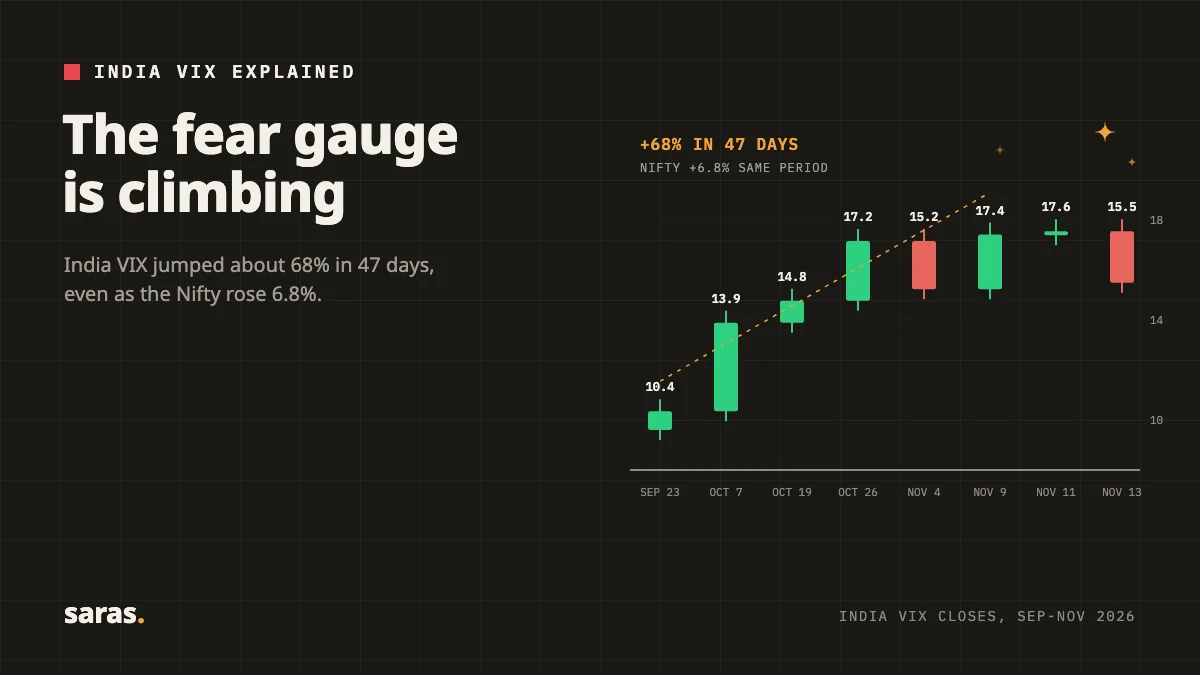
India's stock market has been rising, and so has its fear gauge. Between 23 September and 9 November 2026, the Nifty 50 gained about 6.8%, while India VIX jumped about 68%, from 10.35 to roughly 17.4. That combination confuses a lot of investors. This guide explains what India VIX is, how to read it, why it is climbing now and what it means for your money.
What is India VIX?
India VIX is NSE's volatility index, often called the market's "fear gauge". It shows how much the market expects the Nifty 50 to move, up or down, over the next 30 calendar days. NSE launched it in 2008.
It is built from Nifty option prices, not share prices. NSE takes the best bid and ask quotes of out-of-the-money Nifty calls and puts for the near-month and next-month expiries. It then turns them into one number, using a method adapted from the US CBOE VIX.
The number is an annualised percentage. A VIX of 15 means the options market is pricing in about 15% volatility in the Nifty over a year.
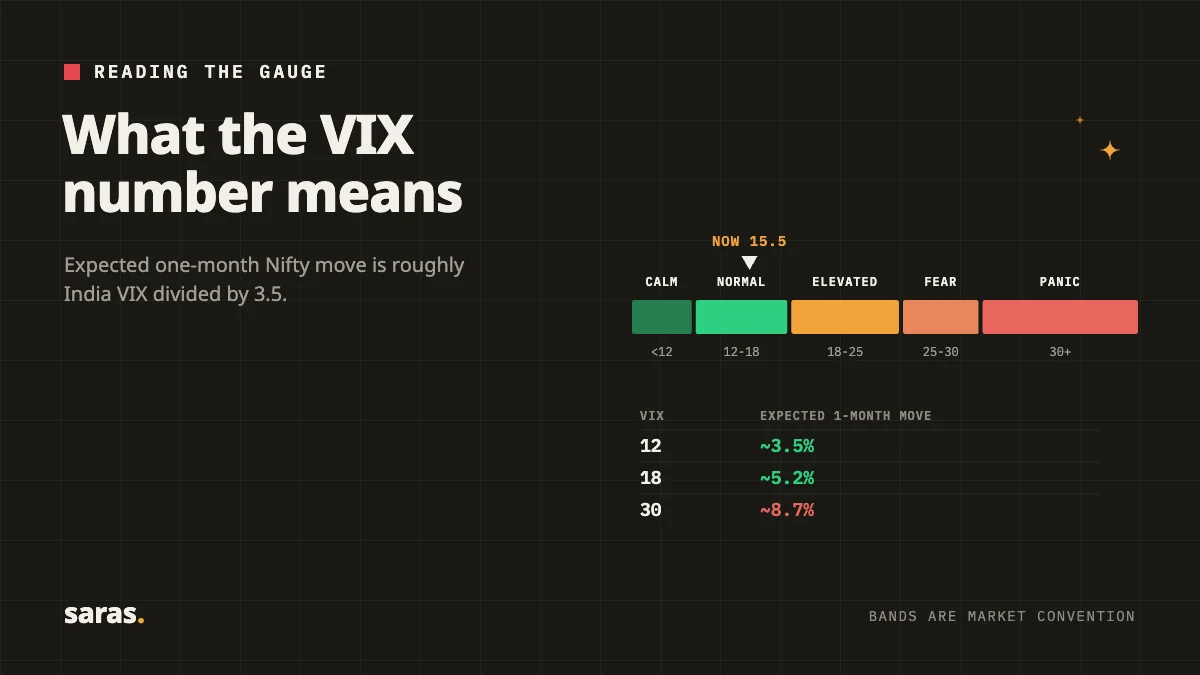
Quick conversion: divide India VIX by about 3.5 (the square root of 12) to get the expected one-month move. At a VIX of 17.5, the market expects the Nifty to stay within roughly 5% either way over the next 30 days, about two times in three.
How to read India VIX levels
India VIX | What it usually signals |
|---|---|
Below 12 | A calm, sometimes complacent market. Options are cheap |
12 to 18 | The normal range. Monthly moves of 3 to 5% are expected |
18 to 25 | Elevated uncertainty and bigger daily swings |
25 to 30 | High fear, often seen during sharp sell-offs |
Above 30 | Panic. Rare, and seen only in major crises |
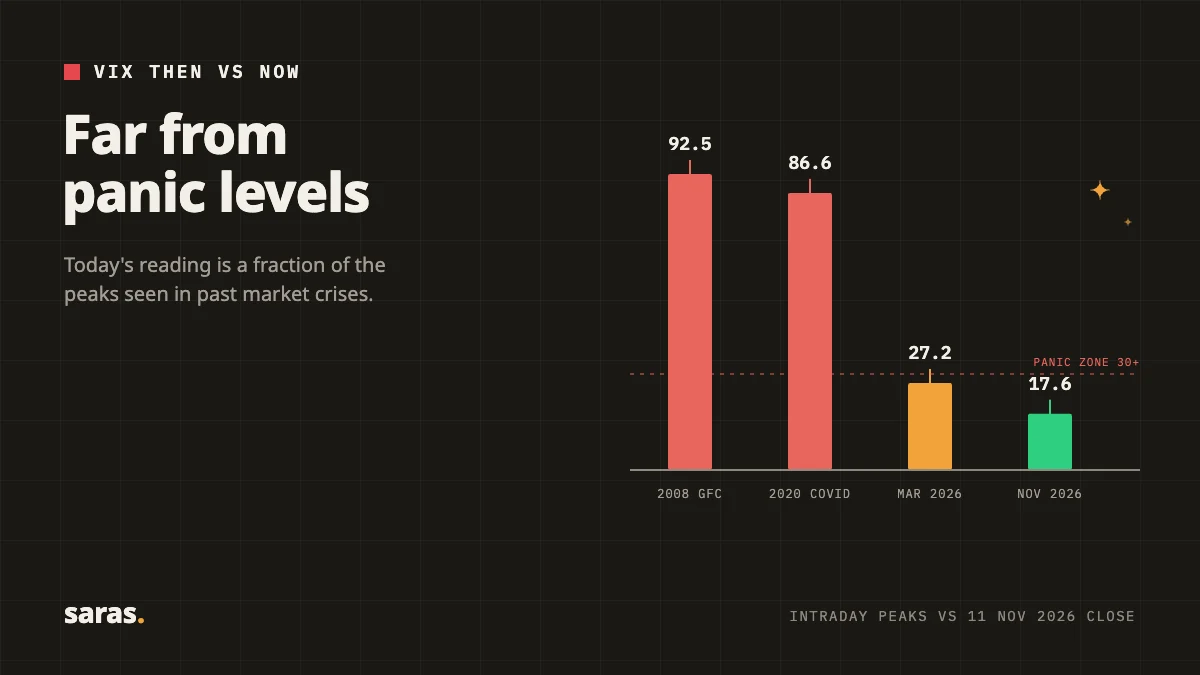
These bands are market convention, not official NSE levels. For context, India VIX's lowest close on record is 9.15, on 26 December 2025. Its highest close is 83.61, on 24 March 2020, during the COVID crash.
Why market volatility is rising now
Volatility has been high for most of 2026. In March, the US-Iran conflict pushed India VIX above 24, and by early November it was up about 61% for the year. The latest climb comes from four things:
- Global inflation and interest rates. US consumer prices rose 0.4% in October, more than expected. That raised worries that the US Federal Reserve will keep rates high, or even raise them again. The US two-year bond yield rose to 4.73%, and a sell-off in global tech stocks added to the nerves.
- India's own inflation. Retail inflation rose to 6.09% in October 2026, above the RBI's upper tolerance limit of 6%. The RBI had already raised the repo rate to 5.5% in October, and a weaker rupee adds to the pressure.
- US-Iran tensions and crude oil. Reports of attacks on energy infrastructure kept oil supply risks in focus, with Brent crude near $92 a barrel. India imports most of its oil, so a jump in crude hits market mood quickly.
- A fast rally. Quick gains with sharp intraday reversals leave traders unsure whether the rally will last. More of them buy options to protect profits or bet on the next big move. That pushes option premiums up, and India VIX with them.
VIX also moves fast in both directions. After closing at 17.55 on 11 November, it fell 6.8% to 15.49 on 13 November.
India VIX and Nifty: why they usually move in opposite directions
Most of the time, India VIX rises when the Nifty falls. In a sharp sell-off, investors rush to buy put options for protection, option premiums jump and VIX spikes. In March 2020, India VIX surged from 25.20 to 64.40 while the Nifty fell nearly 23%.
But the link is not fixed. As November 2026 shows, VIX can also rise during a rally, when traders expect bigger moves in either direction. A rising VIX does not by itself mean a crash is coming.
History suggests that extreme spikes often mark the peak of fear rather than the start of a long fall. One study of past spikes found that the Nifty rebounded in about 75% of cases afterwards. Today's level is also far from crisis territory: India VIX has crossed 60 only twice, during the 2008 global financial crisis and the 2020 COVID crash.
What a rising VIX means for you
- Long-term investors: VIX measures expected swings, not direction, so a higher VIX is not a sell signal. Keep your SIPs running: in choppy months, the same SIP amount buys more units when prices dip. Avoid big decisions made in a panic.
- Option buyers: premiums get more expensive as VIX rises, so you pay more for the same contract. If VIX falls after you buy, your option can lose value even when the Nifty moves your way.
- Option sellers: you collect higher premiums, but the chance of a big move against you is higher too. Keep positions smaller and leave extra margin, because margin requirements tend to rise when volatility does.
- Intraday and swing traders: expect wider daily ranges. Cut your position size so that the rupee risk per trade stays the same, and never widen a stop-loss without shrinking the position.
3 common myths about India VIX
- "A high VIX means the market will crash." It means the market expects bigger moves, which can be up or down.
- "A low VIX means it's safe." A very low VIX can signal complacency. India VIX hit its lowest close ever in December 2025, and volatility rose sharply through 2026.
- "A VIX of 17 means the Nifty will move 17%." The figure is annualised. The expected one-month move is roughly VIX divided by 3.5, so about 5%.
The bottom line
India VIX tells you how bumpy the market expects the next month to be, not where it is headed. Today's reading in the mid-teens is above this year's calm lows but far from panic levels. Long-term investors can mostly stay the course, while traders should respect wider swings by trading smaller.
Disclaimer: Investments in the securities market are subject to market risks. Read all related documents carefully before investing. This article is for investor education only and is not investment advice. Figures are as of 13 November 2026.
Questions and answers
What is a normal India VIX level?
Readings between 12 and 18 are generally seen as normal. Below 12 is calm, and above 25 signals high fear.
Does India VIX predict whether the market will go up or down?
No. It only shows how big the market expects moves to be over the next 30 days, not their direction.
Where can I check India VIX live?
It is listed as "INDIA VIX" on the NSE website and in most broker apps, alongside the Nifty and Sensex.
Can I invest in India VIX?
No. India VIX is an index, so you cannot buy it like a share. Traders take a view on volatility through Nifty options instead.
Why does VIX rise before the Budget, elections or RBI policy?
Traders buy options for protection ahead of big known events, which lifts premiums. VIX often drops sharply once the event is over.
This page is education, not advice. It explains how things work. It does not recommend any security or any action.
- 09Nifty vs Sensex: What's the Difference? A Simple Guide for BeginnersTwo scoreboards, one market. What really separates India's two most-watched indices, why the Sensex number is about three times the Nifty's, and which one you should follow.
- 10SEBI Weighs a Free-Float Cap on MTF: What's ProposedSEBI has not changed any MTF rules yet. It is weighing a proposal to link margin funding in a stock to its free float, but the chairman says no decision has been taken.
Saras is coming soon. Join the waitlist and we will let you know when it opens.