How to Make Money in the Share Market in India: 6 Ways for 2026
Long-term investing, dividends, swing, intraday, F&O and IPOs explained simply, with the risks of each, SEBI data on trader losses and 2026 tax rules.
Microcap Specialist, Research Analyst and 7+ Years in Markets
There is no single way to make money in the share market. You can own good businesses for years, collect dividends, ride price swings over a few weeks, or trade within a single day. Each way needs different time, money and temperament, and each carries a very different level of risk. This guide explains the six main ways in plain language so you can pick the one that fits you.
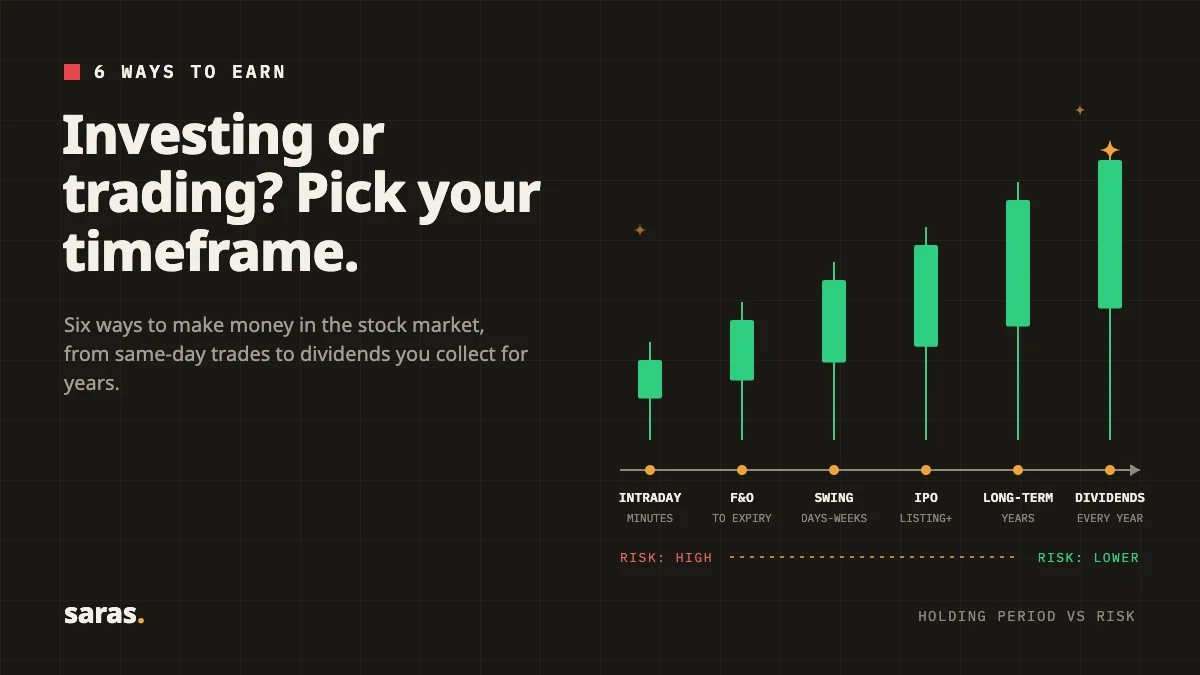
Investing vs trading: the 6 ways at a glance
The big split is between investing and trading. Investors earn from a company's growth over years. Traders earn from price moves over days, hours or minutes, and only if their wins beat their losses and costs.
Way | Holding period | You earn from | Risk | Time needed |
|---|---|---|---|---|
Long-term investing | 1 year or more | Business growth and compounding | Low to medium | Low |
Dividend income | Years | Regular cash payouts | Low to medium | Low |
Swing trading | Days to weeks | Short price trends | Medium to high | Medium |
Intraday trading | Same day | Small price moves, often leveraged | High | Full market hours |
F&O trading | Up to contract expiry | Leveraged price moves | Very high | High |
IPOs | Listing day to years | Listing gains or long-term growth | Medium to high | Low |
1. Long-term investing
You buy shares of strong companies and hold them for years. As the business grows its profits, its share price tends to follow, and your money compounds.
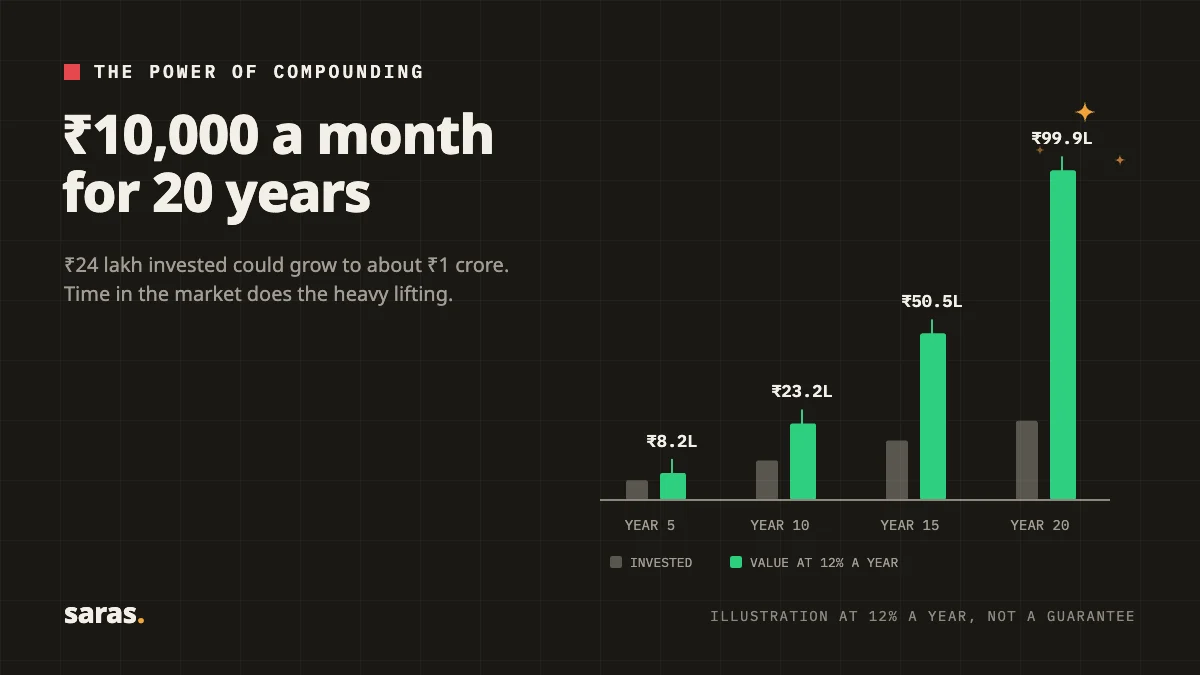
Compounding is the real engine here. Invest ₹10,000 every month for 20 years and you put in ₹24 lakh. At an assumed 12% a year, that could grow to about ₹1 crore. The return is only an illustration, not a promise, but it shows why time in the market matters more than timing it.
How to do it well:
- Buy businesses you understand, with growing sales and profits, low debt and honest management.
- Don't overpay. Compare the P/E ratio with the company's own history and its peers.
- Invest every month instead of waiting for the "right" moment.
- Diversify across 15 to 25 stocks in different sectors. Short on research time? Start with a Nifty 50 index fund or ETF.
- Track quarterly results, not daily prices.
Tax edge: shares held for more than 12 months are taxed at 12.5% on gains above ₹1.25 lakh a year, the lowest rate of any style here.
2. Dividend income
Many mature companies share part of their profit with shareholders as cash dividends. Your return is measured by the dividend yield: the yearly dividend divided by the share price. A ₹500 share paying ₹20 a year yields 4%.
How to pick dividend stocks:
- Look for a long record of paying, and ideally raising, dividends. One big payout proves little.
- Check the payout ratio. A company paying out more than it earns cannot keep it up.
- Be wary of very high yields. They often mean the share price has crashed for a reason.
- Reinvest your dividends to compound faster.
To receive a dividend, you must hold the shares on the record date, so buy at least one trading day before it. Remember that the share price usually drops by about the dividend amount on the ex-date, so a dividend is not free money on its own.
Tax: dividends are added to your income and taxed at your slab rate. The company deducts 10% TDS if it pays you more than ₹10,000 in a year.
3. Swing trading
Swing traders hold a stock for a few days to a few weeks to catch one price move: a breakout, a bounce in an uptrend or a reaction to results. Most use technical analysis such as support and resistance, moving averages and volume, along with news.
Rules that keep swing traders in the game:
- Trade liquid stocks that are in a clear trend.
- Fix your entry, stop-loss and target before you buy. Aim for a reward at least twice your risk.
- Risk only 1 to 2% of your capital on any single trade.
- Keep a trading journal and review what works.
You don't need to watch the screen all day, and you can trade without leverage. The main risk is an overnight gap, when bad news hits while the market is closed. Profits on shares held for 12 months or less are taxed at 20% as short-term capital gains.
4. Intraday trading
Intraday traders buy and sell on the same day, and every open position is closed before the market shuts. They chase small price moves, often with leverage from intraday margin.
The reality check: a SEBI study found that 7 out of 10 individual intraday traders in the equity cash segment lost money in FY23. Among traders under 30, the share of loss-makers was 76%.
If you still want to try:
- Start with paper trading or a very small amount.
- Always place a stop-loss order, and never average down on a losing trade.
- Count every cost: brokerage, STT, exchange charges, GST and stamp duty add up fast over many trades.
- Set a daily loss limit and stop trading for the day when you hit it.
Tax: intraday profit is speculative business income, taxed at your slab rate. Intraday losses can only be set off against speculative income.
5. F&O trading
Futures and options (F&O) are contracts based on an index such as Nifty or on a stock. A small margin controls a much larger position, so both profits and losses are magnified. An option buyer can lose the entire premium if the move doesn't come in time. An option seller collects the premium but can face losses far larger than what was earned.
No other segment has been studied as closely, and the numbers are stark:
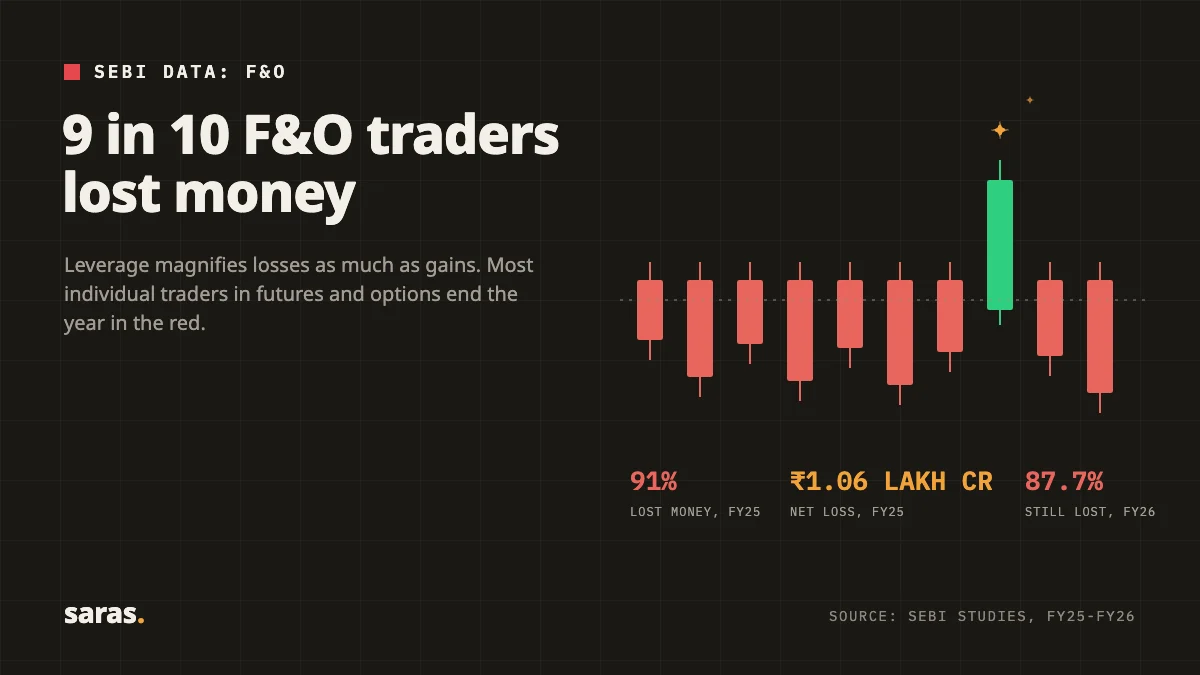
- 91% of individual F&O traders lost money in FY25, with net losses of ₹1.06 lakh crore, according to SEBI.
- 87.7% still lost money in FY26. Total losses were ₹91,685 crore, and the average loss rose to about ₹1.17 lakh per trader.
- Experience didn't fix it. Of traders who started in FY22, only 0.5% were profitable every year through FY26.
Costs went up too. From 1 April 2026, STT on futures rose to 0.05% from 0.02%, and on options premium to 0.15% from 0.10%.
F&O does have sensible uses. You can buy put options to protect a portfolio during a fall, or sell covered calls on shares you already own. If you trade it, learn how time decay and volatility affect option prices, prefer defined-risk strategies like spreads, and use only money you can afford to lose.
Tax: F&O profit is non-speculative business income, taxed at your slab rate.
6. IPOs
In an IPO, a company sells shares to the public for the first time. You can earn from a jump on listing day or by holding a good business for years. You apply through UPI in your broker's app, and the money stays blocked in your account until allotment, not debited. When an IPO is oversubscribed, retail allotment is usually by lottery.
Before you apply:
- Read the RHP (offer document): what the business does, how it will use the money, and its valuation against listed peers.
- Check who is selling. A large offer for sale (OFS) means existing owners are cashing out, and none of that money goes into the business.
- Ignore the hype. The grey market premium (GMP) is unofficial and unregulated, and listing gains are never guaranteed.
- Take extra care with SME IPOs, which are smaller and much harder to sell when prices fall.
Tax at a glance
Income | How it is taxed |
|---|---|
Shares held more than 12 months | 12.5% on long-term gains above ₹1.25 lakh a year |
Shares held 12 months or less | 20% on short-term gains |
Dividends | Your slab rate; 10% TDS above ₹10,000 a year from one company |
Intraday (equity) | Speculative business income, slab rate |
F&O | Non-speculative business income, slab rate |
Surcharge and cess apply on top. The ₹12 lakh tax-free limit under the new regime does not cover capital gains taxed at these special rates. If you trade very often, your delivery trades may also be treated as business income, so check with a chartered accountant.
Which way is right for you?
- Beginner with a job and little time: long-term investing through monthly SIPs in quality stocks or an index ETF, with dividend stocks as a steady base.
- Can check the market a few times a week and want to learn charts: swing trading with a small part of your capital.
- Intraday and F&O: only after real experience, with a small slice of money you can afford to lose.
Rules for every style:
- Keep an emergency fund of about six months of expenses before you invest.
- Never trade on tips from unregistered Telegram or WhatsApp "experts". Verify their SEBI registration first.
- Use stop-losses and keep each position small.
- Never invest borrowed money.
- Measure your real return after costs and taxes, not just your winning trades.
The bottom line
Most lasting wealth in the share market comes from owning good businesses for a long time. Trading can pay, but it takes skill, discipline and strict risk control, and the data shows most people lose. Start with investing, learn as you go, and trade only with money you can afford to lose.
Disclaimer: Investments in the securities market are subject to market risks. Read all related documents carefully before investing. This article is for investor education only and is not investment advice. Returns shown are illustrations, not guarantees. Tax rules are as of November 2026; confirm with a tax adviser.
Questions and answers
How much money do I need to start investing in the share market?
There is no minimum. You can buy a single share or start an SIP with a few hundred rupees. Start small and add as you learn.
What is the safest way to make money in the stock market?
Long-term investing in diversified, quality stocks or index funds carries the lowest risk of the six ways. No stock investment is risk-free, though, and prices can fall for long periods.
Can I make a living from intraday or F&O trading?
A small minority do, but SEBI data shows close to 9 in 10 F&O traders lose money. Don't quit your job or use your savings to trade full time.
What do I need to start?
A demat and trading account with a SEBI-registered broker, plus PAN, Aadhaar and a bank account. Account opening and KYC can be done fully online.
This page is education, not advice. It explains how things work. It does not recommend any security or any action.
- 07Why Kaynes Technology Shares Fell 20%: Profit, Debt and Auditor ReviewKaynes Technology shares fell up to 20% after Q2 FY27 results. Here is what the NSE filing shows on profit, net debt and the auditor's qualified review.
- 08India VIX Explained: Why Market Volatility Is RisingIndia VIX jumped about 68% in seven weeks even as the Nifty rallied. What the fear gauge measures, how to read it and what it means for your money.
Saras is coming soon. Join the waitlist and we will let you know when it opens.