How to Check If a Stock Advisor Is SEBI Registered
Got a trading-signal offer on Telegram or WhatsApp? Verify the advisor's SEBI registration in 5 minutes and spot the red flags of fake advisors.
Microcap Specialist, Research Analyst and 7+ Years in Markets
That Telegram channel promising "90% accurate" intraday calls may not be operating legally at all. In India, anyone who sells stock tips or trading signals must be registered with SEBI as a Research Analyst or an Investment Adviser. Checking takes about five minutes, and this guide shows you exactly how.
Pay an unregistered advisor and you lose every protection: no grievance route, no accountability, and little chance of getting your money back.
What "SEBI registered" actually means
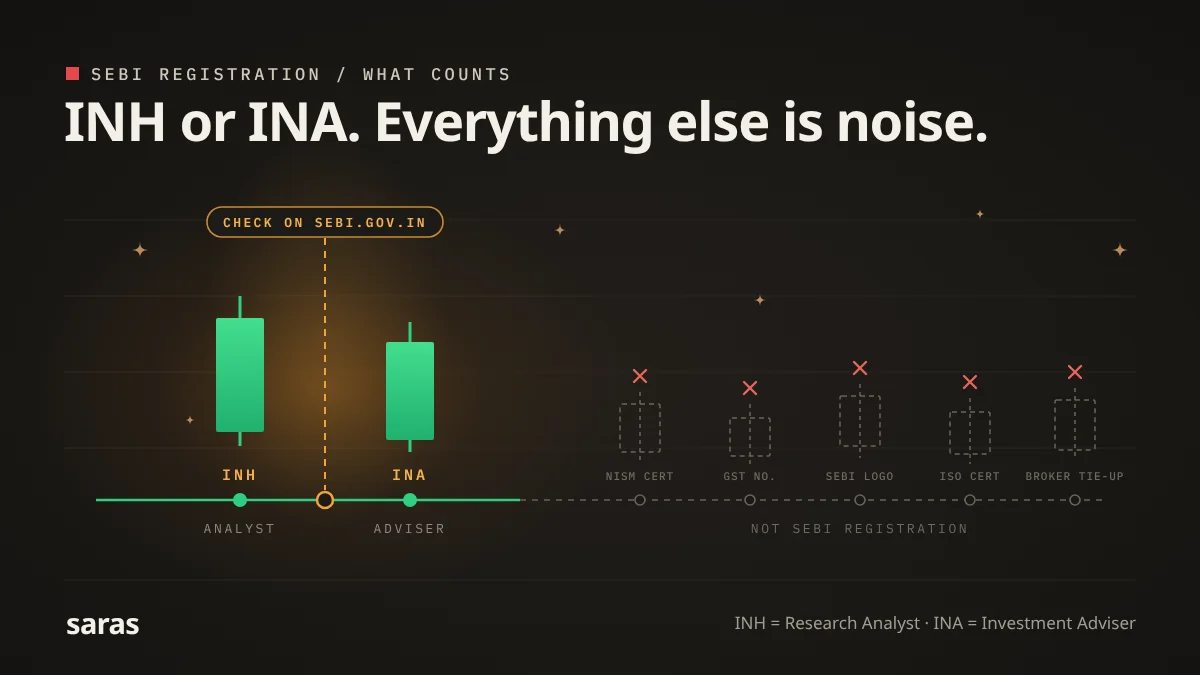
Two SEBI registrations allow someone to give you stock recommendations for a fee. Most trading-signal services fall under the first one, so INH is the number you will usually look for.
Research Analyst (RA) | Investment Adviser (IA) | |
|---|---|---|
What they do | Research and buy/sell/hold calls, including trading signals | Personalised advice based on your goals and risk profile |
Registration number starts with | INH | INA |
Rules that apply | SEBI (Research Analysts) Regulations, 2014 | SEBI (Investment Advisers) Regulations, 2013 |
These are NOT a SEBI registration, even though fake advisors often show them as proof:
- A NISM certificate. It is an exam qualification, not a licence to sell tips.
- A GST number, company incorporation, Udyam/MSME or ISO certificate. These say nothing about permission to give stock advice.
- A "SEBI certificate" image or logo on a website. Anyone can paste one. Only SEBI's own website counts.
- A tie-up with a broker or an "authorised partner" badge. Ask for an INH or INA number specifically.
Step-by-step: how to verify a stock advisor
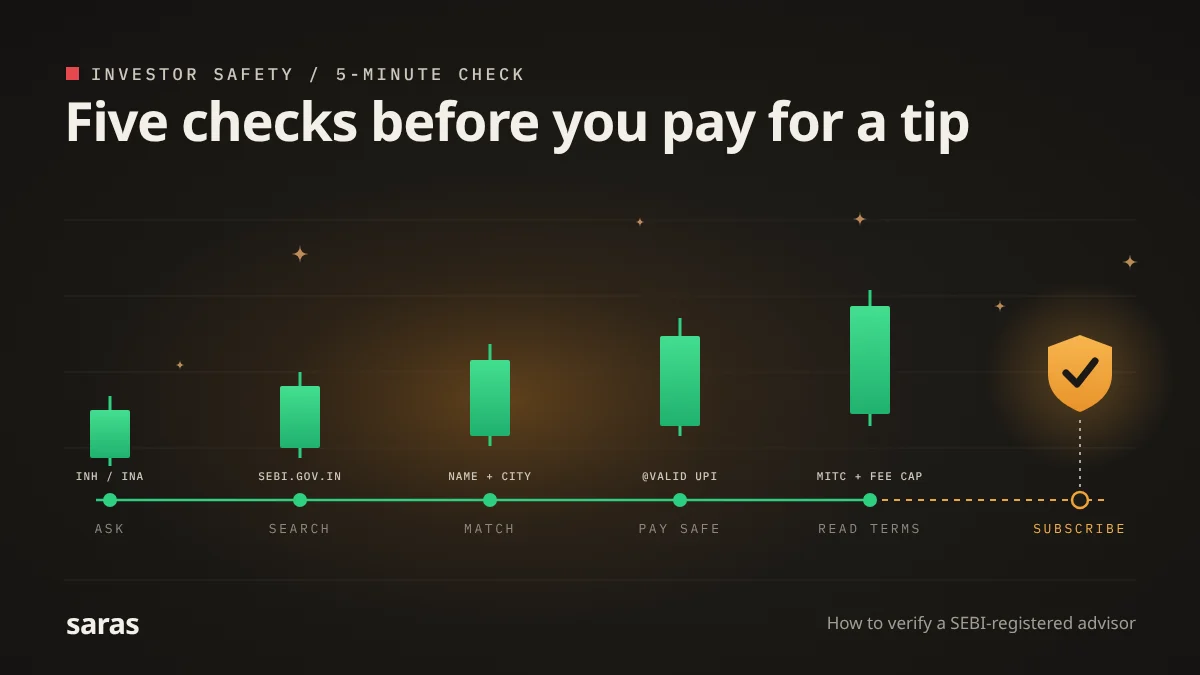
Step 1: Ask for the registration details
Ask for three things: the registered name, the registration number and the registration type. The registered name is the legal name on SEBI's records, not the brand or channel name. A genuine advisor shares this without hesitation.
Since 1 May 2026, SEBI-registered entities must show their registered name and registration number on the home page of every social media handle. They must also show it at the start of each securities-related post or video, including in closed groups. A channel giving calls without this is your first red flag.
Step 2: Search SEBI's official register
- Type sebi.gov.in into your browser yourself. Do not use a link the advisor sends you.
- Open the Intermediaries section and choose Recognised Intermediaries.
- Select Research Analyst (or Investment Adviser).
- Search by name or registration number.
No match? Stop here and do not pay. Avoid third-party lists and "verified advisor" directories, which can be outdated.
Step 3: Match every detail, not just the number
Scammers rarely invent a number. They copy a real analyst's INH number and put it on their own website or channel. SEBI has acted in cases where an unregistered firm used another analyst's registration number to collect fees.
Compare the SEBI record with what the advisor shows you:
- Name: does the registered name match the website, invoice and payee name?
- Contact: are the email and phone the same as the ones messaging you?
- Address: does the city match?
- Status: is the registration active, not suspended or cancelled?
Still unsure? Contact the advisor using the email or phone listed on SEBI's site and ask whether the channel or group is really theirs.
Step 4: Verify where your money goes
Since 1 October 2025, SEBI-registered intermediaries that deal with investors, including research analysts and investment advisers, collect payments through UPI IDs with the exclusive "@valid" handle (for example, name.brk@validhdfc for a broker). The middle tag shows the type of intermediary. When you pay a valid ID, your UPI app shows a thumbs-up icon in a green triangle.
Before you pay a single rupee:
- Check the payee on SEBI Check, available on SEBI's website and its Saarthi app. Enter the @valid UPI ID, or the bank account number and IFSC.
- Match the account name with the registered name. A personal account in someone else's name is a deal-breaker.
- Never pay cash. Research analysts accept fees only by cheque, bank transfer or UPI.
- Consider CeFCoM, an optional fee-payment platform run by BSE where only registered RAs and IAs can receive money.
Step 5: Read the terms before you subscribe
Registered RAs must share their Most Important Terms and Conditions (MITC) and sign an agreement with you. Check these points:
- Fee cap: for individual and HUF clients, an RA can charge at most ₹1,51,000 a year per family for all research services, excluding statutory charges. Investment advisers have the same cap under the fixed-fee mode.
- Advance fee: no more than one year in advance. "Lifetime" plans paid upfront do not fit the rules.
- Refunds: if the service ends early, you can claim the fee for the unused period.
- Grievances: the terms must say how to complain, starting with the RA and escalating to SEBI.
Red flags of fake stock advisors
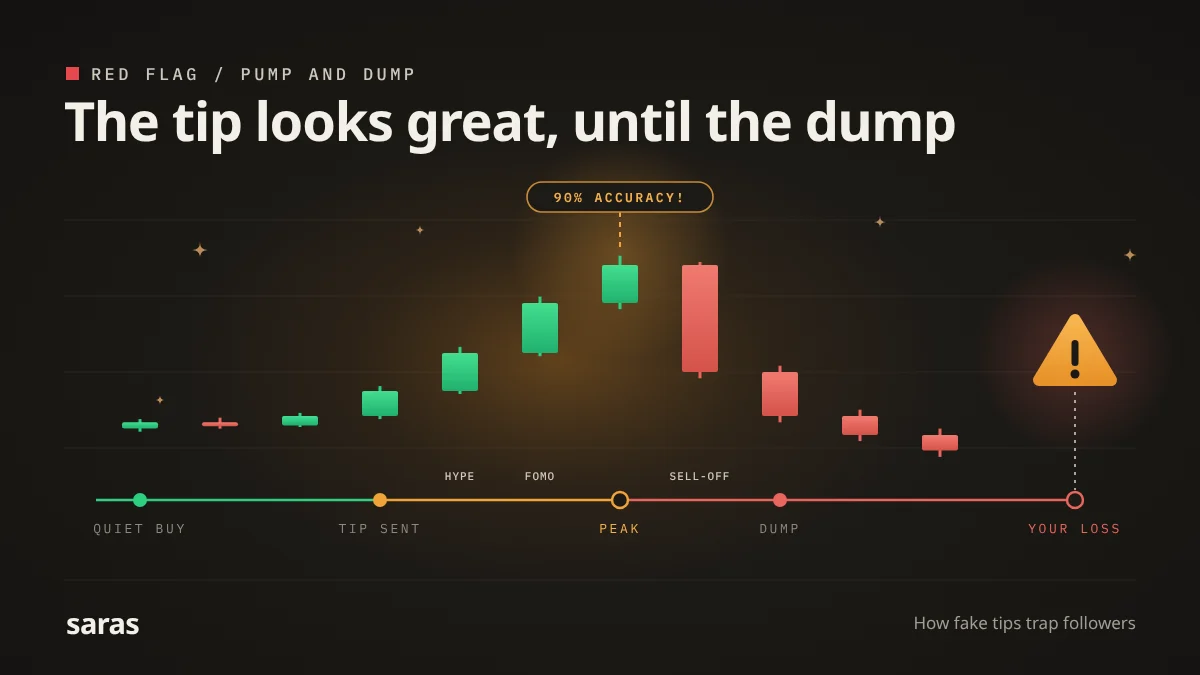
If you spot even one of these, walk away.
- Guaranteed returns. "90% accuracy", "fixed 5% a month", "zero-loss strategy". SEBI bars registered research analysts from offering assured-return schemes or guaranteeing profits.
- "Share your login, we'll trade for you." RAs cannot place trades for you. They also cannot ask for passwords or OTPs for your trading, demat or bank accounts.
- Profit-sharing deals. "Pay us 30% of your profit" is not how registered advisers work. They charge a disclosed fee within SEBI's limits.
- Payment to personal accounts. Also random UPI IDs, crypto wallets or cash.
- Invitation-only WhatsApp groups. In October 2026, SEBI warned about such groups run by unregistered "experts", often from overseas numbers, in the name of free education. Planted members post fake profit screenshots, and when a group gets banned, a new number invites everyone to a "replacement" group.
- Unverified performance claims. P&L screenshots prove nothing. Since May 2026, SEBI's Past Risk and Return Verification Agency (PaRRVA), run by CARE Ratings with NSE, certifies advisers' past performance. Ask: "Is this PaRRVA-verified?"
- A push to a new app or platform. SEBI tells investors not to open accounts or send money on apps recommended by such groups.
- Hot tips in SME or penny stocks. These are classic pump-and-dump targets. In May 2026, SEBI barred seven people in an alleged ₹20.25 crore scheme that used tips on X, Telegram and WhatsApp to pump SME stocks.
- "Loss recovery" packages. Promises to win back your past trading losses are bait.
- Pressure to act now. "Only 3 seats left", "offer ends tonight", "buy before 9:30".
Already paid a fake advisor? Act fast
Speed matters most in the first few hours.
- Stop paying. Fraudsters often demand "tax", "upgrade" or "unlock" fees before releasing your so-called profits.
- Call 1930 or report at cybercrime.gov.in. A quick report can help freeze the money in the receiving account.
- Alert your bank or UPI app and ask them to flag the transaction.
- Save evidence: chats, phone numbers, group links, website screenshots and payment receipts.
- Contact SEBI on its toll-free helpline, 1800 266 7575 or 1800 22 7575. If the advisor is SEBI registered, file a complaint on SCORES (scores.sebi.gov.in) and escalate to SMART ODR if it stays unresolved.
- Report the phone numbers on the government's Sanchar Saathi portal, and alert NSE or BSE.
Quick checklist before you pay
Save this and run through it every time.
- I have the advisor's registered name and INH or INA number.
- I found it on sebi.gov.in, and the status is active.
- The name, contact details and city match SEBI's record.
- The registration appears on their social profile and at the start of their posts.
- My payment goes to an @valid UPI ID or an account verified on SEBI Check, in the registered name.
- I received the MITC and agreement, and the fee is within ₹1.51 lakh a year.
- There are no guaranteed returns, no login or OTP requests and no profit-sharing.
The bottom line
No registration number, no deal. Five minutes on sebi.gov.in can save you lakhs, so verify first and pay later.
Official links: SEBI · SCORES complaints portal · SEBI investor website · National Cyber Crime Portal
Disclaimer: This article is for investor education only and is not investment advice. Rules cited are as of November 2026; check sebi.gov.in for the latest.
Questions and answers
Is a NISM certificate the same as SEBI registration?
No. NISM certification is a qualification needed before applying for registration. On its own, it does not allow anyone to sell stock tips.
Can a SEBI-registered advisor guarantee returns?
No. SEBI prohibits research analysts from offering assured or guaranteed returns. Anyone promising them is breaking the rules, registered or not.
Are free tips on Telegram or WhatsApp safe?
Free is not the same as safe. Free calls in small stocks are a common pump-and-dump tool: the operators sell while followers buy.
What is the maximum fee a research analyst can charge?
₹1,51,000 a year per family for individual and HUF clients, excluding statutory charges. No more than one year can be collected in advance.
What does INH mean in a SEBI registration number?
INH is the prefix SEBI gives to research analysts. Investment advisers get INA. A trading-signal seller showing neither is not registered for that work.
How do I know a UPI ID belongs to a SEBI-registered advisor?
Registered intermediaries use UPI IDs with the "@valid" handle, and your UPI app shows a thumbs-up icon in a green triangle when you pay one. You can also confirm the ID, or a bank account and IFSC, on SEBI Check.
Can I get my money back from a fake stock advisor?
There is no guarantee, but speed improves your chances. Report it on 1930 or cybercrime.gov.in at once, so the receiving account can be frozen, and alert your bank.
This page is education, not advice. It explains how things work. It does not recommend any security or any action.
- 05FII DII November 2026: FIIs Net Buy Rs 79,302 Cr, DIIs Sell Rs 49,089 Cr in First HalfForeign investors turned aggressive buyers in the first half of November 2026, while domestic institutions booked profits. Here's the full FII vs DII cash-market breakdown.
- 06How to Make Money in the Share Market in India: 6 Ways for 2026Long-term investing, dividends, swing, intraday, F&O and IPOs explained simply, with the risks of each, SEBI data on trader losses and 2026 tax rules.
Saras is coming soon. Join the waitlist and we will let you know when it opens.