How stock tip scams on messaging apps trap traders
Free groups, screenshots of profits, a "VIP" plan and an app that will not let you withdraw. Here is how the trap works, step by step, and how to check anyone before you pay.
Research and Analysis. Writes about F&O and risk.
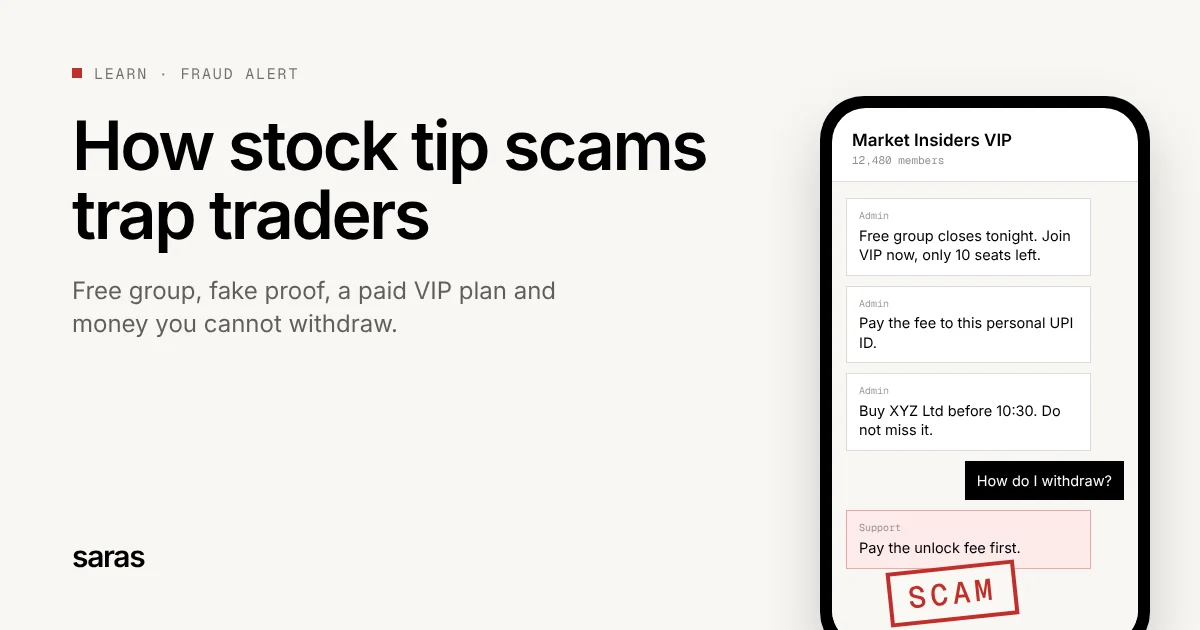
It usually starts with a message you did not ask for. A stranger adds you to a group on a messaging app. The group has a confident name, thousands of members and a steady flow of stock "tips". Within days, people in the group are posting screenshots of profits and thanking the admin.
Most people who lose money to these groups are not careless. The scam is built in stages, and each stage is designed to make the next one feel normal.
How the trap is set
1. The free group
The first weeks cost nothing. The admin posts a few stock names a day, often large, well-known shares that move anyway. Some of them go up, and those are the ones that get talked about. The losing ones are quietly forgotten or deleted.
Many of the "members" cheering in the chat are fake accounts run by the same people. Their job is to make the group look busy and successful.
2. The proof
Next come the screenshots: profit and loss screens, bank credits, messages from "happy members". None of them can be checked. They are easy to edit and easy to copy from other groups.
3. The VIP plan
Once you trust the group, you are invited to a paid "VIP" or "premium" group with "sure-shot" stock names. The fee is paid to a personal UPI ID or bank account, not to a registered company. There is no agreement, no registration number and no way to get the money back.
4. The pump and dump
In the VIP group, the messages change. Instead of large shares, you are told to buy a small, thinly traded stock, say XYZ Ltd, "before the news comes out". Thousands of members buy at the same time and the price jumps.
The people running the group bought earlier at a lower price. While members are buying, they sell. When they stop, the buying dries up and the price falls back, often below where it started. The members are left holding the shares.
SEBI has taken action against groups that worked this way, including bans from the market.
5. The fake trading app
The newer version skips the stock market altogether. You are sent a link to download a "trading app" or open an "institutional account" with special access to IPOs or block deals. The app is not on the official app store, or it copies the look of a real one.
The app shows your money growing fast. Then you try to withdraw. Suddenly there is a "tax", a "service fee" or an "unlock charge" to pay first. Each payment leads to another. The profits were never real, and neither was the account.
6. The recovery call
After people lose money, a new message arrives: someone claiming to be a lawyer, a police officer or a "recovery agent" who can get it back, for a fee. This is the same scam, a second time.
Why it works on careful people
- Other people seem to be winning. A busy chat full of thank-you messages feels like proof, even when the accounts are fake.
- The first win is real. Early suggestions are often large shares that were going up anyway, so trust is built on luck.
- There is always a deadline. "Only 10 seats left", "buy before 10:30". Pressure leaves no time to check.
- It looks official. Fake certificates, borrowed logos, the photo of a well-known investor, a website that looks like a broker's.
- Money already spent. After paying for VIP, it is hard to admit it was a mistake, so people pay again to "recover" it.
Red flags
If you see any one of these, stop:
- A promise of fixed or "guaranteed" returns, or "no loss" trades.
- No SEBI registration number, or one that does not match the name you see.
- Payment to a personal UPI ID or a personal bank account.
- An app you have to install from a link instead of the official app store.
- Being asked to share your trading login, OTP or PIN, or to let someone "trade for you".
- A fee you must pay before you can withdraw your own money.
- Being told to keep it secret or not to discuss it with family.
How to check before you pay or act
- Ask for the SEBI registration number. Anyone who gives stock recommendations for a fee must be registered with SEBI as a research analyst or an investment adviser. Their number should be on every message and on their website.
- Look it up yourself. Search the name or number in the list of registered intermediaries on sebi.gov.in. Check that the name, the category and the dates match.
- Pay only through a verified handle. Since 1 October 2025, SEBI-registered intermediaries collect payments through UPI IDs on the "@valid" handle. You can check any UPI ID, QR code or bank account with the SEBI Check tool on the SEBI website before you pay.
- Use only a registered broker's official app. Download it from the official app store or the broker's own website. Your shares sit in a demat account in your name, and the exchanges and depositories send you messages for your trades and holdings. If you get no such messages, the "account" is not real.
- Never share your login, OTP or PIN. No genuine adviser or broker needs them.
If you have already been caught
- Stop paying. No real platform asks for money to release your own money.
- Report it quickly. Call the national cyber crime helpline on 1930, or file a complaint at cybercrime.gov.in. The sooner you report, the better the chance that the money can be frozen.
- Tell your bank about the payments you made.
- Save everything: chat screenshots, phone numbers, UPI IDs, payment receipts and app names.
- Ignore recovery offers from anyone who contacts you first.
- Complain to SEBI through SCORES if the person or firm claims to be SEBI-registered.
The short version
A real research analyst shows a registration number you can check, takes payment through a verified channel, and never promises returns. Whoever you follow, check them first. It takes two minutes, and it is the cheapest protection you will ever buy.
This page is education, not advice. It explains how things work. It does not recommend any security or any action.
- 02Happy Diwali from SarasHq Team!This Diwali, may your portfolio shine brighter than the diyas! From all of us at SARAS - thank you for trusting us! Shubh Deepavali!
- 03Upcoming IPOs in India: 5 SEBI-Approved Issues to Watch Before 2026 EndsFive big companies have SEBI's go-ahead but no price band yet. Here is where each IPO stands, what the numbers say, and why FY26 proved a hot IPO is not a guaranteed listing gain.
Saras is coming soon. Join the waitlist and we will let you know when it opens.